

You already know the problem. You sent the quote, felt good about it, and then — nothing. A few days of silence while the homeowner is comparing bids, talking to a spouse, or simply busy. That silence isn’t a rejection. It’s a gap. And the contractor who closes it first is usually the one who gets the job.
This guide doesn’t re-explain why follow-up matters. It gives you the timing, the exact messages to send, and a process you can use on every quote you send starting today.
Why Most Contractors Don’t Follow Up — And Why It Costs Them Jobs
One Quote Is Not a Sales Process
Sending a quote is the start of a sales conversation, not the end of one. Most homeowners don’t respond immediately — not because they’re uninterested, but because life gets in the way. Work, family, another contractor they’re also comparing. The estimate sits in their inbox. They mean to respond. They don’t.
A contractor who sends one quote and waits leaves that conversation half-finished. The one who follows up — at the right time, in the right way — is usually the one who gets the reply. Understanding why contractors lose leads after estimates starts with that gap between “quote sent” and “follow-up done.”
What Homeowners Are Doing While You Wait
While you’re watching your inbox, the homeowner is probably still gathering quotes, waiting on a second opinion, or getting comfortable with the budget. None of those things mean they’ve moved on. They often haven’t. They’re waiting for someone to re-engage them with confidence.
That’s the window. And most contractors miss it by assuming silence is rejection. It usually isn’t.
The Simple Fix: A Repeatable Process
You don’t need a complex sales system. You need a defined sequence — what to send, when to send it, and how many times. Once that’s in place, follow-up stops being something you remember to do and becomes something that just happens on every quote.
When to Follow Up: A Timing Framework That Works
The timing framework below works for most home service jobs — residential remodels, painting, roofing, landscaping, HVAC, and similar trades. Adjust for the size and complexity of the project.
Why Day 1 Matters More Than Day 3
The first 24 to 48 hours after sending a quote are when the homeowner’s attention is highest. They just reviewed your proposal. They have questions forming. If you show up in their inbox at exactly that moment with a clean, confident confirmation, you stand out from every other contractor who sent a quote and disappeared.
Don’t skip Day 1 because you think it’s too soon. It isn’t.
What to Say: Follow-Up Templates for Each Stage
Copy and adapt these templates to your voice. The variables in [brackets] should be replaced with specific details — a generic message reads like a mass text, which is worse than no message at all.
Day 1 — Confirm Receipt (Text)
Day 1 — Confirm Receipt (Email)
Day 3 — Check-In
Day 7–10 — Closing Follow-Up
Closing Message — If No Reply
DripJobs triggers follow-up sequences after every estimate — so the right message goes out at the right time, without you tracking it manually.
What Makes a Follow-Up Message Work (And What Kills It)
The Difference Between a Message That Gets a Reply and One That Doesn’t
Follow-up messages fail for one of two reasons: they’re too generic to feel like a real message, or they push too hard and make the homeowner feel cornered. The templates above avoid both. Here’s what separates effective follow-up from the kind that gets ignored.
Text vs. Email: Which Gets Read First?
For most residential jobs, text outperforms email for speed — open rates are higher and response times are shorter. That makes text the better choice for Day 1 and Day 3, especially for homeowners who communicate casually.
Read faster, feel more personal. Works well for most residential jobs under $10K. Match the register of how the client first contacted you.
Works well when the original estimate was sent by email, or for commercial / larger jobs where a text feels too informal. Easier to reference attachments.
When in doubt: mirror the channel the client used first. If they called, follow up by phone. If they emailed, reply to that thread. Consistency reduces friction.
How Many Times Should You Follow Up on a Quote?
The 2–3 Touch Rule
Two to three follow-ups over 7 to 10 days is the right baseline for most home service jobs. That’s enough contact to stay present — not enough to become intrusive. One follow-up is rarely enough; messages get missed, clients get busy. Three touches over ten days is a process. One touch is a guess.
When Job Size Changes the Equation
For larger, more complex jobs — full roof replacements, kitchen remodels, commercial work — a longer timeline makes sense. These decisions involve more people and more money, and clients who are genuinely interested will appreciate a contractor who stays engaged without becoming pushy. Four or five touches spread over two to three weeks is reasonable.
For smaller jobs — a gutter cleaning, a patch repair, a single-room paint — two touches is usually enough. The decision timeline is shorter and the stakes are lower.
Reading the Silence
No reply after three messages is usually an answer. The homeowner may have hired someone else, decided to wait, or moved on entirely. A professional closing message preserves the relationship without keeping you in a loop that’s already closed. Some clients come back months later — and they remember the contractor who didn’t harass them.
Why Manual Follow-Up Breaks Down at Scale
The Tracking Problem
Every contractor who follows up manually is dealing with the same invisible problem: they have to remember. Remember which quote went out last Tuesday. Remember who they already followed up with once. Remember whose Day 3 message is due today and whose Day 7 is tomorrow.
That works when you’re sending two or three quotes a week. It breaks down the moment you’re doing ten, fifteen, or more. The follow-up that didn’t happen isn’t because you forgot on purpose — it’s because the system failed.
The Bandwidth Problem
You’re running a business. Managing crews, scheduling jobs, handling material orders, fielding calls. Follow-up is important — but it competes with everything else on your list. The days when you’re busiest are exactly the days when manual follow-up falls apart, and those are also the days when you’re probably sending the most quotes.
What a System Does That Memory Can’t
A defined follow-up process — whether manual or automated — removes the dependency on memory. When a quote goes out, the next step is already scheduled. You don’t have to decide whether to follow up or when. The answer is pre-set. That’s the difference between a system and a habit.
How Contractors Automate Follow-Ups After Every Quote
What CRM Follow-Up Automation Actually Looks Like
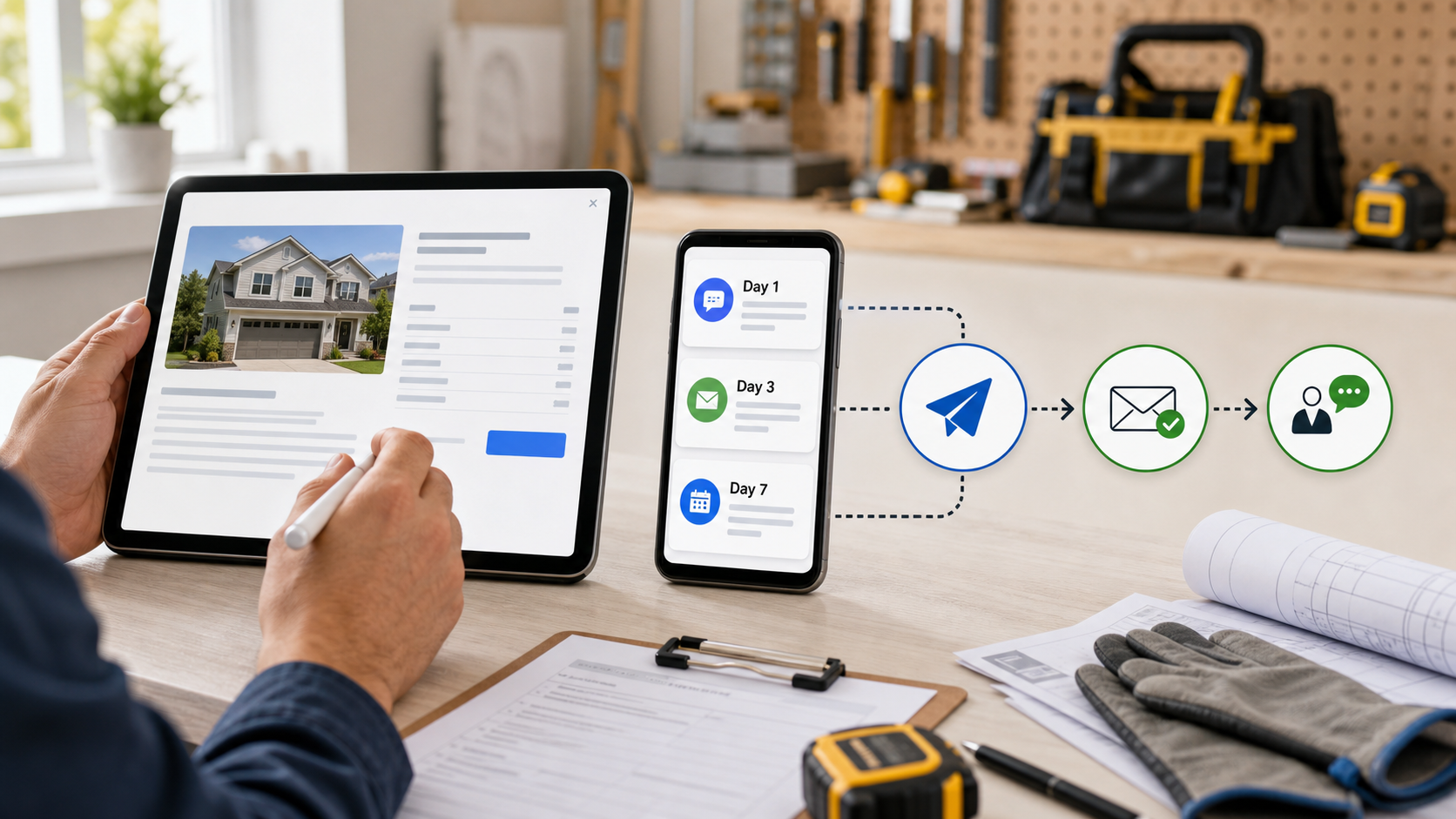
For contractors, automation means this: a quote goes out, and a follow-up sequence triggers automatically. The timing is preset. The messages go out on schedule — Day 1, Day 3, Day 7 — without you doing anything. If the client replies, the sequence stops. If they don’t, the next message goes out as planned.
That’s the entire workflow. It’s not complicated software — it’s a process that runs in the background while you’re on a job site, in your truck, or handling something else.
How DripJobs Handles Follow-Ups Automatically
Is Automation Right for Every Contractor?
If you’re sending fewer than five quotes a week and follow-up is manageable with a simple reminder, a full CRM may be more infrastructure than you need right now. The templates above will serve you well with a manual process.
If you’re regularly missing follow-ups because of volume, forgetting leads after a busy week, or spending time on check-ins you’d rather automate — that’s the signal that a system is worth it. The time saved on follow-up alone tends to pay for the subscription.
Frequently asked questions
Following Up Is Part of the Job — Not Optional
Most contractors treat follow-up as something extra — something they’ll do when they have time. That’s the wrong frame. Follow-up is the second half of the sales process. You’ve already done the work of showing up, doing the estimate, and submitting the quote. Not following up is leaving that work half-finished.
The templates in this guide give you something to send starting today. The timing framework tells you when. Once both are in place, the only question is whether you run that process manually or let a system handle it in the background.
Either way: the biggest mistake is the one most contractors make by default — sending the quote and waiting for the homeowner to come back on their own.
This post contains affiliate links. If you make a purchase through these links, we may earn a commission at no extra cost to you.